
Worldbuilding that survives chapter forty.
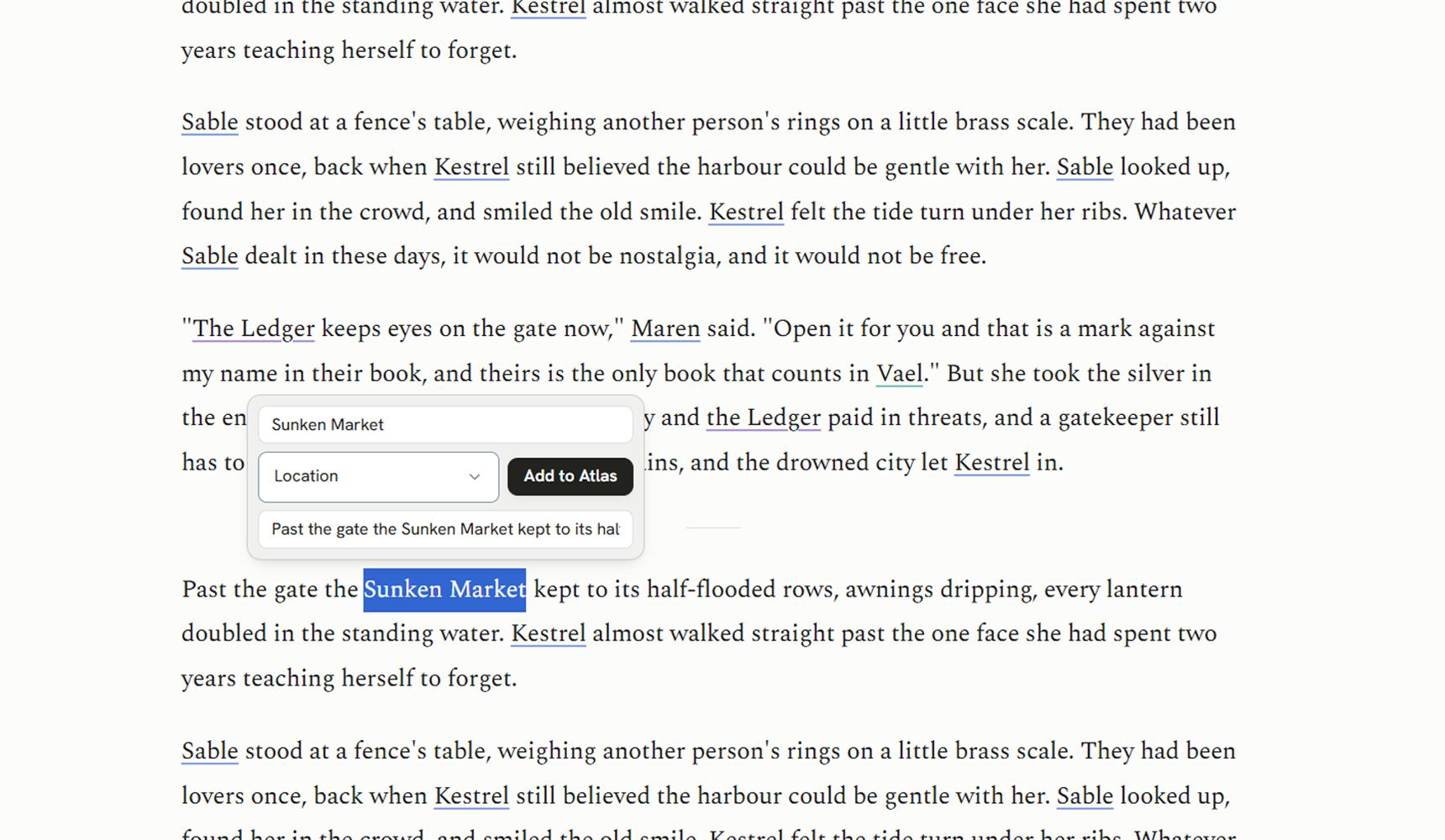
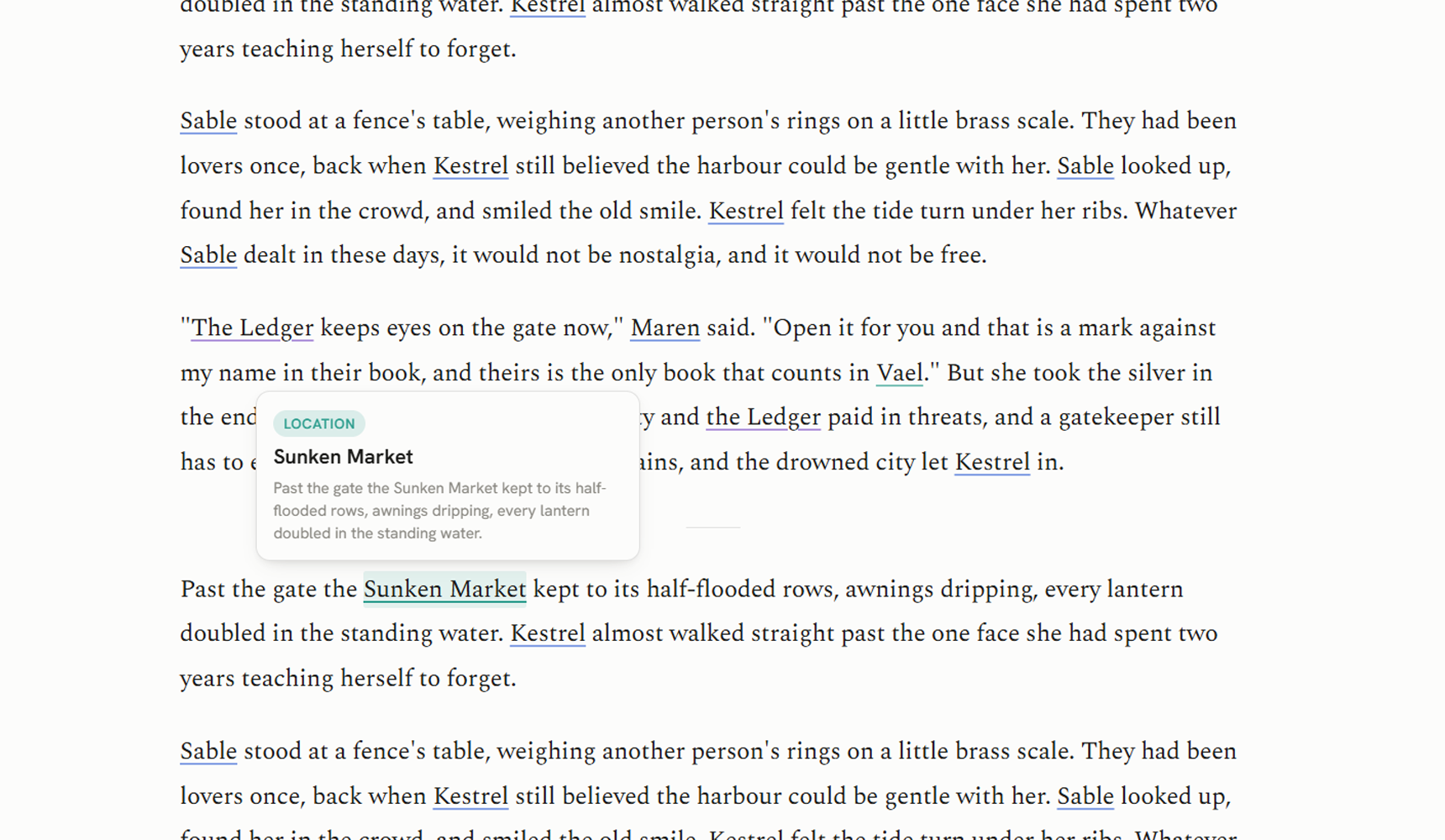
Select a name in your prose and the Atlas takes it without you leaving the sentence. From then on the editor knows it, and every entry of its kind carries the fields your story actually needs.
Worldbuilding and manuscript, one workspace
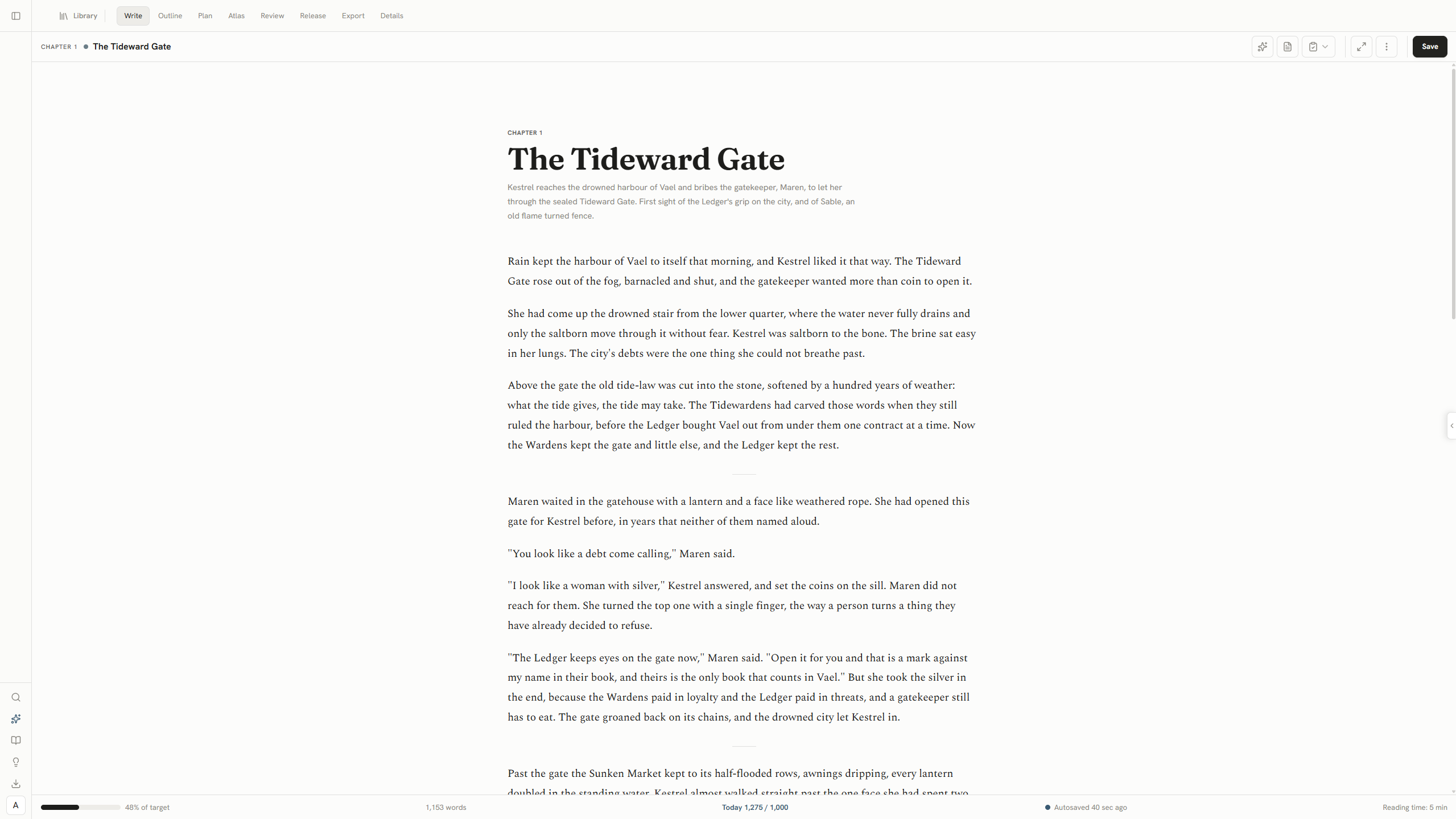
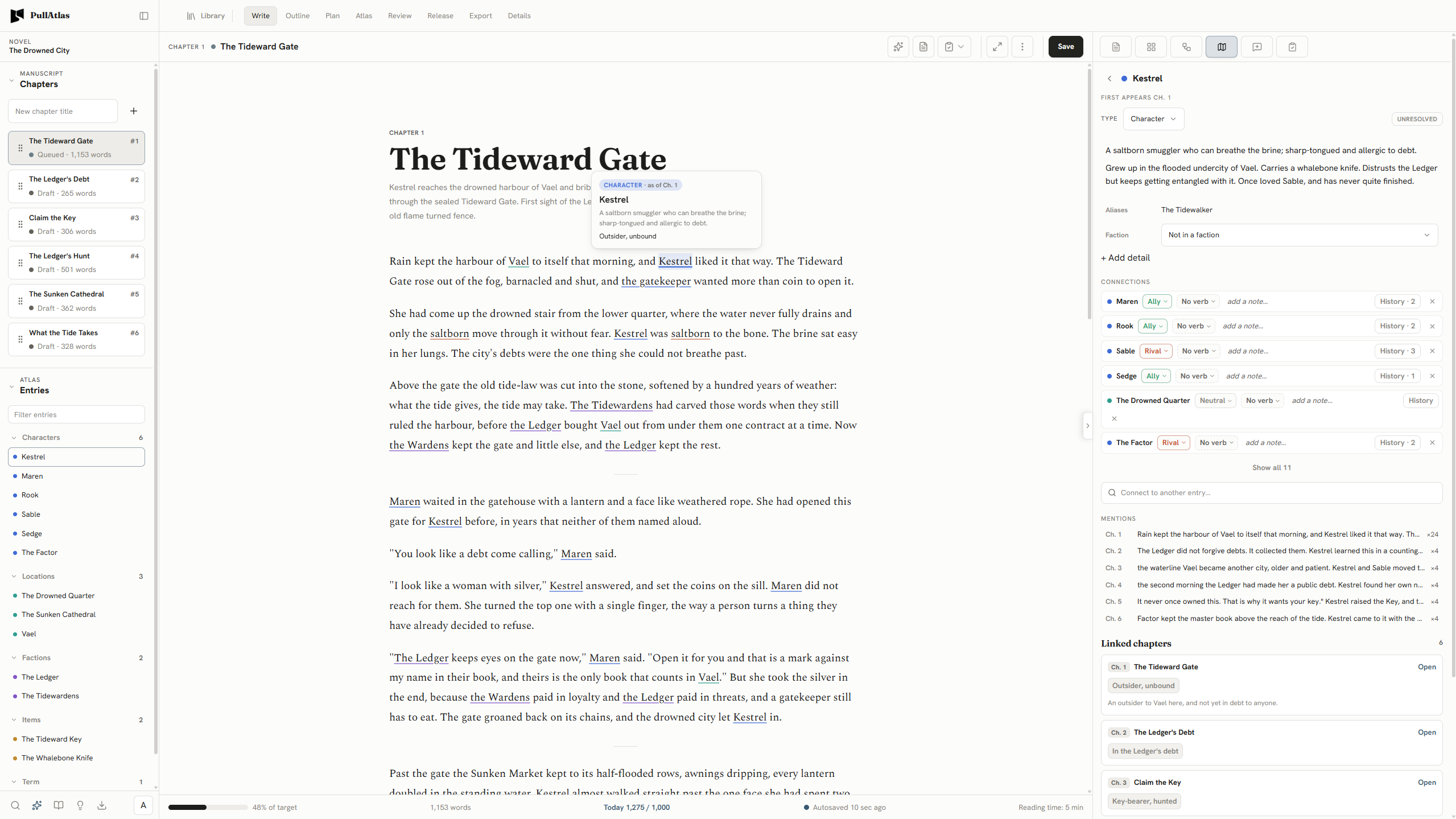
Characters, factions, places, magic systems, and plot in one connected atlas, beside an editor that already knows them. Stop keeping your story straight across six documents and a spreadsheet.
Nobody stops writing because the sentences got hard. They stop because the book got too big to hold in their head.
Her eyes were grey in chapter three and blue in nineteen, and a reader found it first. The spreadsheet of ages and timelines has been rebuilt three times. The series bible is split across six documents that disagree, and every session starts with four chapters of rereading before you can write one.
Select a name in your prose and the Atlas takes it without you leaving the sentence. From then on the editor knows it, and every entry of its kind carries the fields your story actually needs.
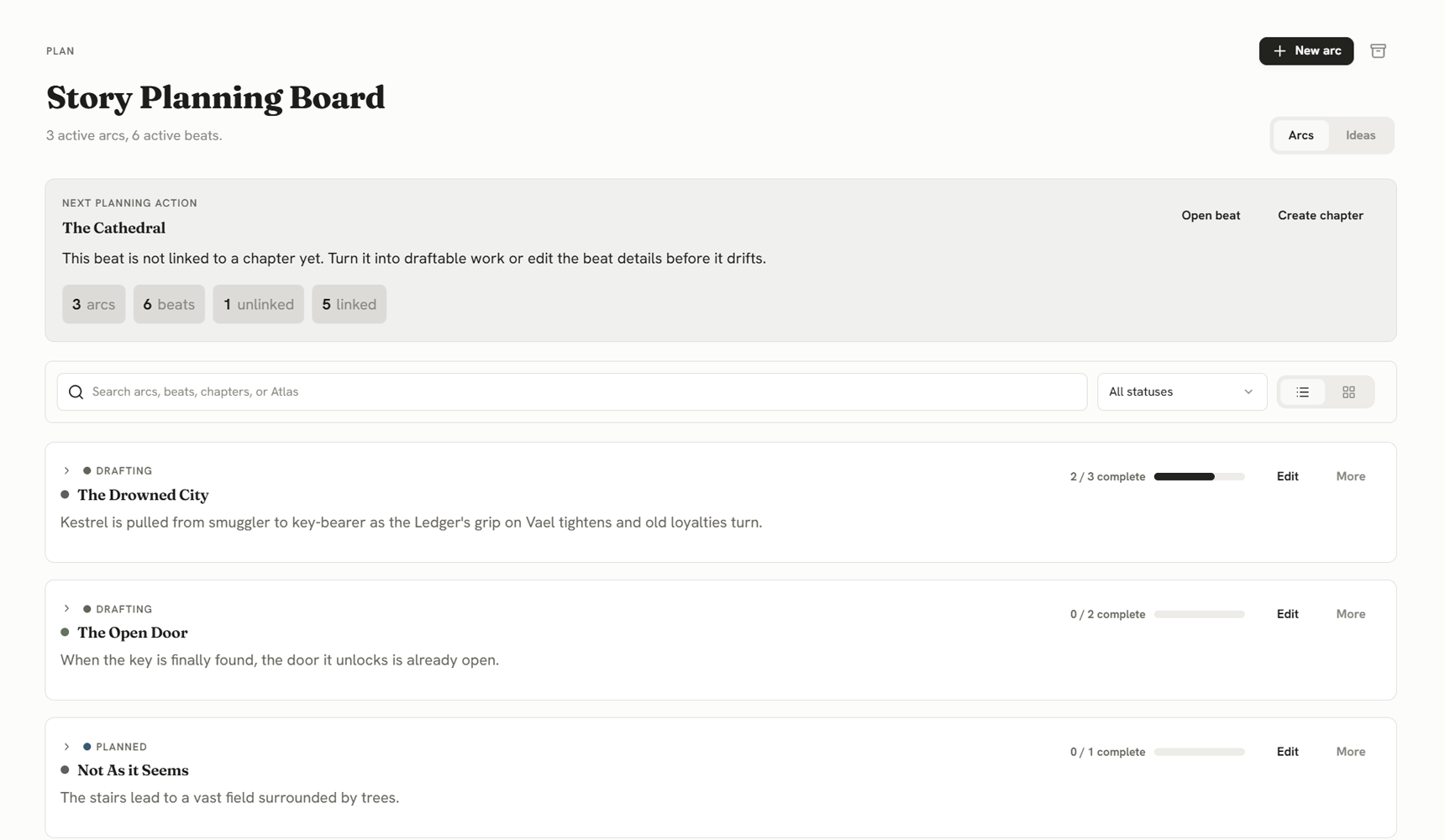
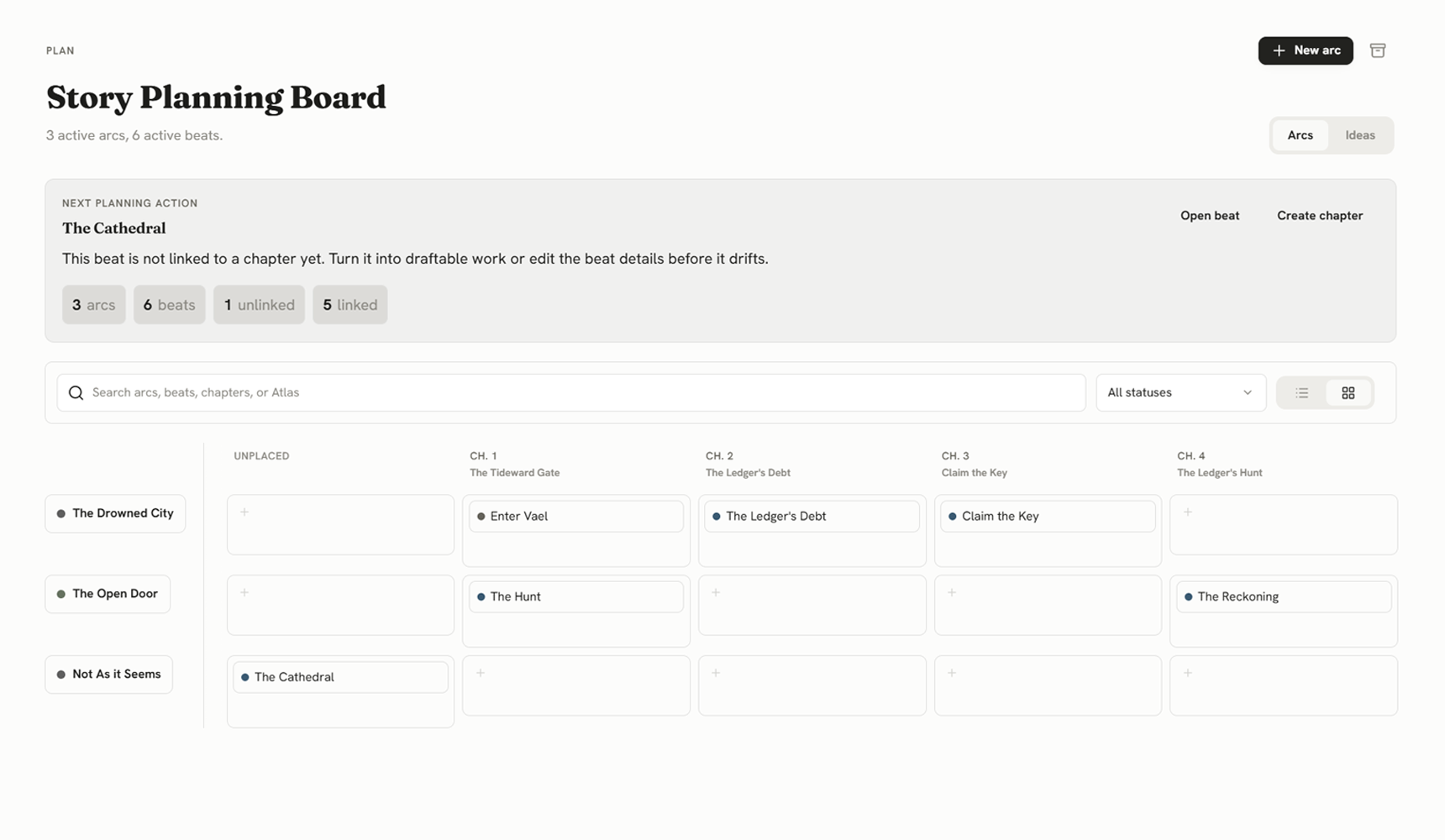
Arcs and the beats inside them, each tied to the chapter that carries it, so you can start writing from the beat you are standing on and the plan never drifts into a second book.
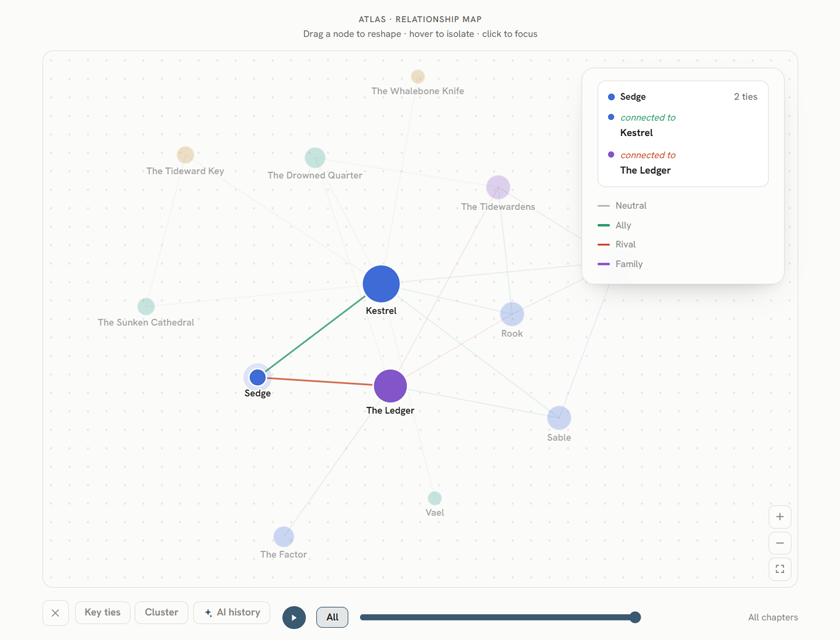
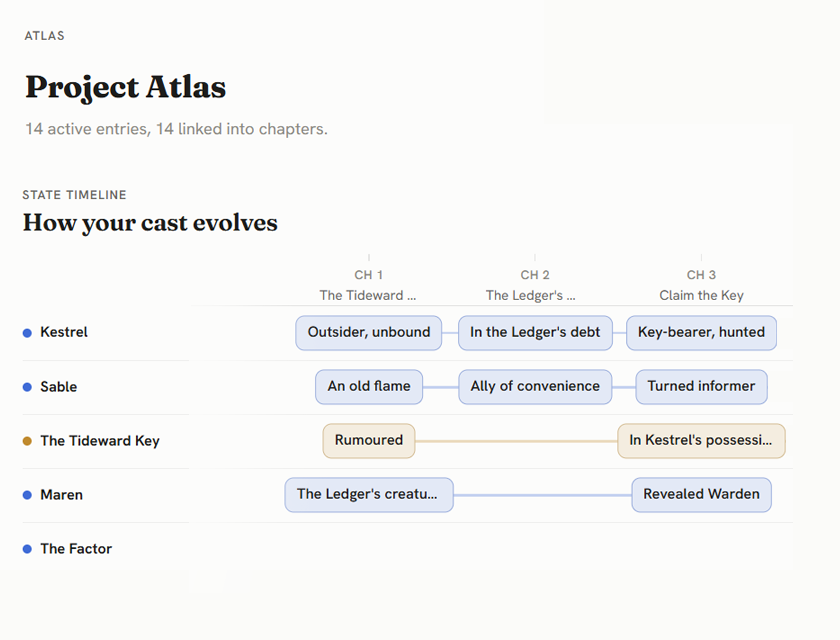
The relationship map draws your cast as a web and replays it chapter by chapter, as loyalties shift. The timeline lays how everyone evolves beside the chapters that changed them, so you track the moving parts at a glance.
PullAtlas keeps a full copy of your project in a database on your own device and syncs it to your account. A dropped connection, or a bad day on our side, pauses syncing and not writing. A complete backup is free on every plan. How your work is kept safe.
Every AI feature uses a key you bring from Claude, ChatGPT, Gemini, or OpenRouter, free on every plan. You pay your provider their own rates, usually pennies, with no markup from us and no allowance to run out. Prefer to write without it? The workspace is complete without AI.
PullAtlas is built by one writer who kept losing track of their own world. It is new, it ships most weeks, and the roadmap is public, because the honest thing to do with a young tool is show you where it is going. See the roadmap.
Questions
First of all. Plan a release chapter by chapter and schedule it, or plan a whole book release, with the formatting each platform expects. Continuity checks read your canon and flag the contradiction before a reader meets it, and the relationship map replays chapter by chapter, so the tie you set up in chapter nine is still there in ninety.
You never start from nothing. Open a chapter and the beat it belongs to is already there, with what has to happen and who is in the room. Ask for a brief and it arrives grounded in your own canon, not a generic outline. Catch an idea at the wrong moment and it waits in Ideas until you want it.
Drop the file in. Your draft comes in as chapters, not one enormous block, and you see exactly how it split before anything is created. Paragraphs, emphasis, and scene breaks come across; the stray styling from your word processor does not. Then build the Atlas from what is already written, by hand or with the extract tools.
No reader-facing pages, no public profiles. Your manuscripts are visible only to your account. We never use your work to train AI models.
Export a complete backup or a clean manuscript file whenever you like. Deleting your account is one click, not an email.
Free to write, with no card. The paid plans add more room and more craft tools, and every price is on the pricing page.
Free to write, no card, your own AI key. The world builds itself as you go.