

How to keep continuity straight past chapter 100
Nobody loses continuity in chapter three. It goes somewhere around chapter forty, when the cast is too big to hold in your head and the archive is too long to search by memory.
Every serial writer has the same moment. A reader comments, politely, that Ellis had grey eyes in chapter 12 and green ones in chapter 88. They are right. You go back and check, and it takes twenty minutes, and the fix is one word, and the whole time you are thinking: what else is wrong that nobody has noticed yet.
This is a method for not having that moment. It is deliberately small. Most continuity systems fail not because they are wrong but because they cost more to maintain than a writer posting weekly can afford.
Why serials break
A novel and a serial fail continuity in completely different ways, and most advice you will find is written for the novel.
In a novel, chapter 3 is provisional until the day you publish. Notice in chapter 40 that you changed someone's eye colour and you fix chapter 3. The draft is soft. Continuity errors are a revision problem, and revision is a phase you have not reached yet.
A serial has no soft draft. Chapter 3 went up eighteen months ago. It has comments on it. Some readers have reread it. You can edit the text, and you should, but you cannot edit the fact that it was read. The archive is the canon, and in practice it is immutable.
Two other things make it worse:
You write slower than they read. You wrote chapters 1 to 90 over two years. A reader binged them in a fortnight. They are holding the whole story in working memory. You are holding the chapter you posted on Tuesday.
The cast grows without ceremony. Nobody plans to have 60 named characters. You introduce a shopkeeper in chapter 14 to move a scene along, and forty chapters later that shopkeeper is a subplot, and nowhere did you decide to start tracking her.
What to track
The instinct is to build a wiki. Full worldbuilding, every faction, the magic system's internal rules, a map, a timeline going back four hundred years.
Do not do this. Not because worldbuilding is bad, but because the maintenance cost of a wiki scales with your chapter count, and yours is going up every week. Wikis built in enthusiasm at chapter 20 are abandoned by chapter 60, and an abandoned continuity record is worse than none, because you will trust it once more before you find out it is stale.
Track only what a reader could catch you on. The test is a single question:
Could a reader quote a chapter at me about this?
If the answer is no, it is not a continuity fact, it is worldbuilding, and worldbuilding does not create contradictions. Nobody has ever been called out for changing their mind about something they never put on the page.
What survives that test is narrower than you would think, and it is mostly boring:
- Names, spellings and titles. Including the ones you only used once.
- Physical details you stated specifically. Eye colour, height, a scar, a limp, an accent.
- Family and relationships. Who is whose sister, and who knows it.
- Numbers. Ages, distances, how many days the journey takes, how much money changed hands.
- Injuries and their timelines. The broken arm you gave someone in chapter 30 that was fine in chapter 32.
- Who knows what. More on this one, because it is the big one.
That last category causes more continuity failures than every physical detail combined, and it is the one almost nobody tracks. A character acts on information they were never told. You know it, because you know the whole plot, and by chapter 70 you genuinely cannot remember which revelations happened on the page and which happened only in your outline. Readers catch this instantly and it damages a story far more than an eye colour does, because it makes the plot feel arbitrary.
The first-appears rule
If you take one thing from this, take this.
For every person, place and object worth tracking, record the chapter it first appeared in and exactly what you said about it there.
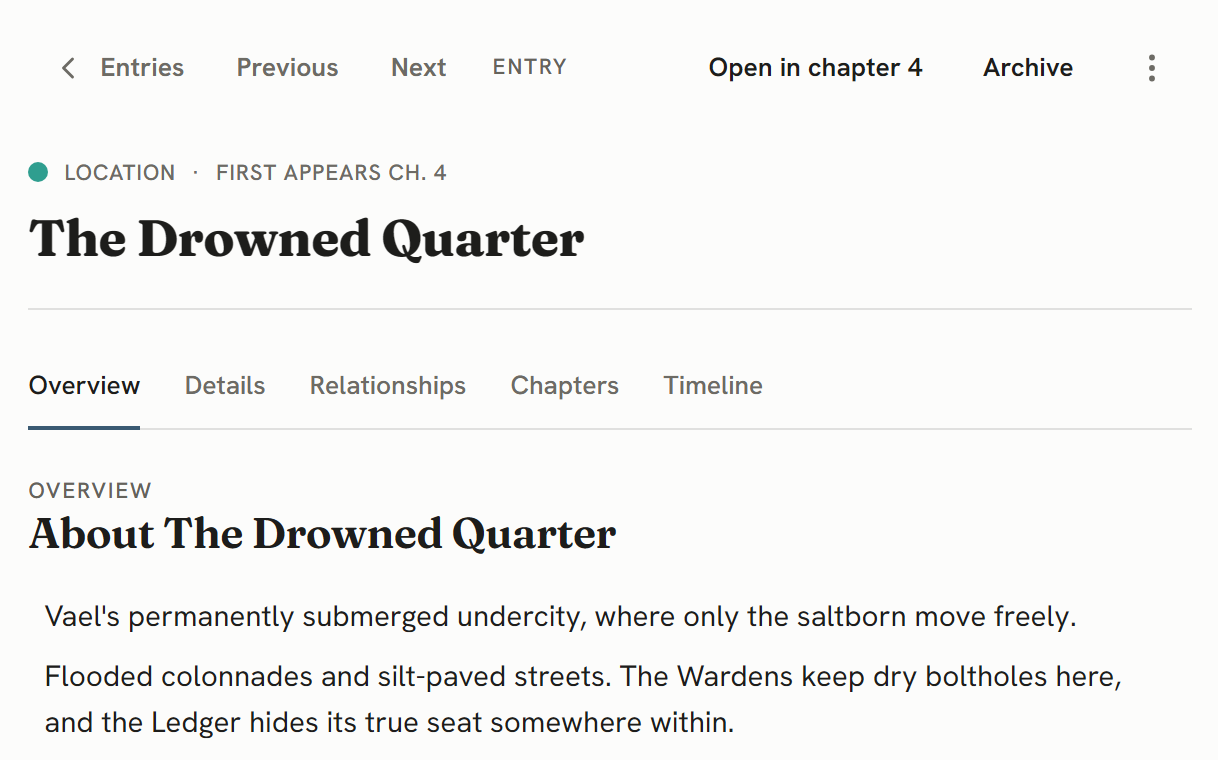
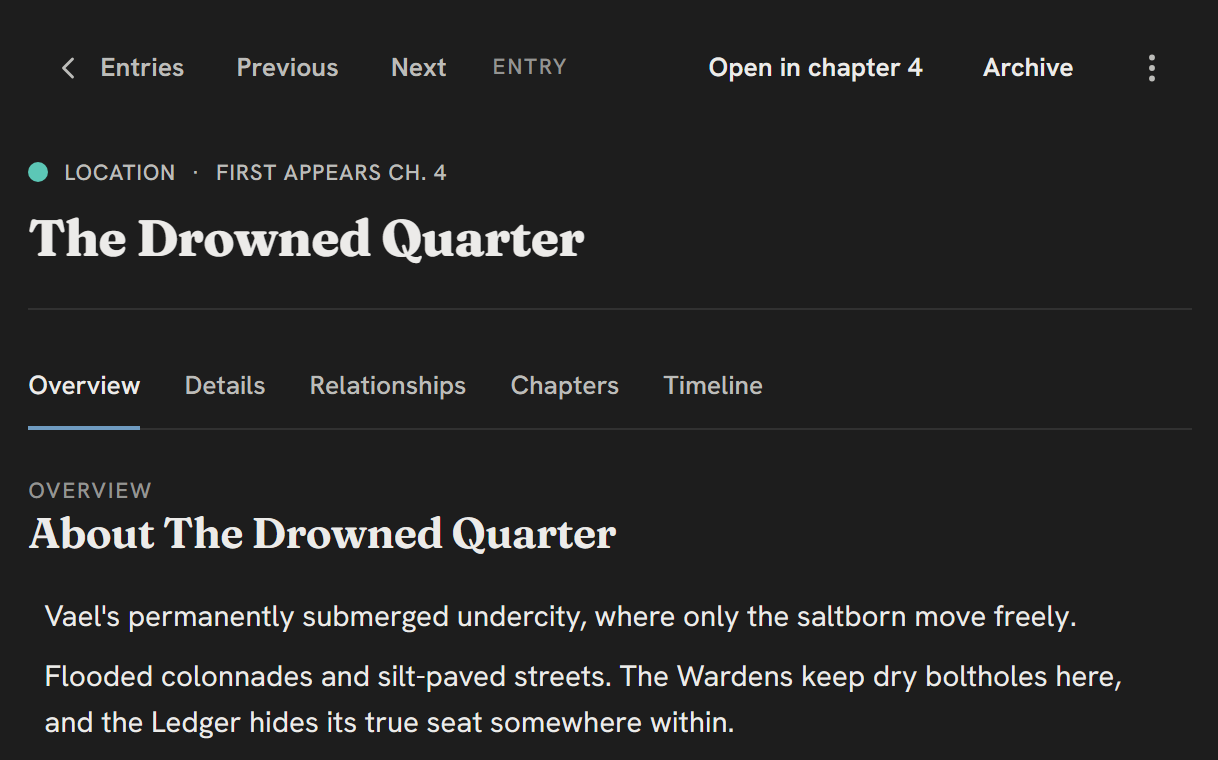
Not a summary. What you actually wrote. If chapter 12 says "grey eyes, and the flat look of someone who has stopped expecting much", record that.
The reason is that contradictions are almost never with the recent statement. They are with the first one. You remember what you wrote last month perfectly well. What you have lost is the offhand detail from chapter 12, written in a hurry, that has been sitting there being canon ever since while you rebuilt the character in your head into someone slightly different.
First-appears also solves the problem of finding things. "Where did I introduce the Hollow Court?" is a question you will ask perhaps thirty times over a long serial, and every time you ask it without a record, it costs you fifteen minutes of scrolling.
This is one field per entity. It is the cheapest thing on this list and it does the most work.
Fixed versus changing
Here is the failure that survives even a well-kept story bible.
A character sheet says: Rank: Captain. Written at chapter 20, true at chapter 20. At chapter 80 he has been stripped of the rank in a scene you were quite proud of. The sheet still says Captain. It is not out of date in a way you will notice, because you only open it when you have forgotten something, and you have not forgotten the demotion, it was a big scene. So the sheet sits there being quietly wrong until the day you check it for something else and believe it.
The fix is to separate two genuinely different kinds of fact.
Fixed details are true for the whole story. Where someone was born, who their mother is, the colour of their eyes, what happened to them before chapter 1. Record these once. They are canon and they do not move.
Changing details are only true as of a chapter. Rank, location, allegiance, what they believe, who they trust, what they know, whether they are alive. These must carry a chapter number or they are actively dangerous.
Once you separate them, the question you can finally answer is the one that actually comes up: not "what is true about Ellis" but "what was true about Ellis at chapter 60", which is the question you need when you are writing chapter 61.
This is the shape PullAtlas uses: fixed facts live on the entry, and anything that moves is recorded as a state at a chapter, so scrubbing back to chapter 60 shows you the story as it stood then. But the idea matters more than the tool. A spreadsheet with a "chapter" column does the same job.
When to record
Not while drafting. Not in a monthly catch-up session.
Record at publication. The moment a chapter goes live is the only trigger that is already reliably in your routine, and it is the moment a fact stops being provisional and becomes canon. Two minutes after you hit post: anything new or changed in that chapter goes in the record.
Monthly catch-up sessions fail for an obvious reason once you say it out loud. You are recording from memory. Memory is the thing that already failed. That is why you are doing this.
Drafting-time recording fails differently: you record a detail, then cut the scene, and now your continuity record contains a fact that is not in the story. That is worse than a missing entry, because it will contradict something you write later and you will have no idea why.
The rule is clean, and it is the whole discipline: nothing enters the record until it is published.
Catching up
Most people reading this are not at chapter 1. They are at chapter 90 with nothing written down and a growing sense of dread.
Do not reread your archive. Ninety chapters is a week of work and you will not do it, and knowing you should is what has stopped you starting at all.
Do this instead:
-
Start with the active cast. Whoever appears in your current arc. Usually six to ten people. Record them properly, working backwards from recent chapters to find their first appearance.
-
Then go lazy. From now on, when you are about to write a character who has no entry, record them then, before you write the scene. You were going to check your facts anyway. The only new cost is writing down what you find.
-
Let the tail stay untracked. The shopkeeper from chapter 14 who has not appeared since does not need an entry. If she comes back, she gets one at step 2. The characters you never look up are exactly the characters you cannot contradict.
Within one arc this gets you to complete coverage of everyone who matters, at a cost of a few minutes per character, spread across weeks you were writing anyway.
The dread comes from imagining the full audit. There is no full audit. There is just: write the next chapter, and write down what it made true.